
Technology Trend – Autonomous Artificial Intelligence
December 4, 2025
Technology Trend – Autonomous Artificial Intelligence
Trend Analysis: The Transition from Generative to Autonomous
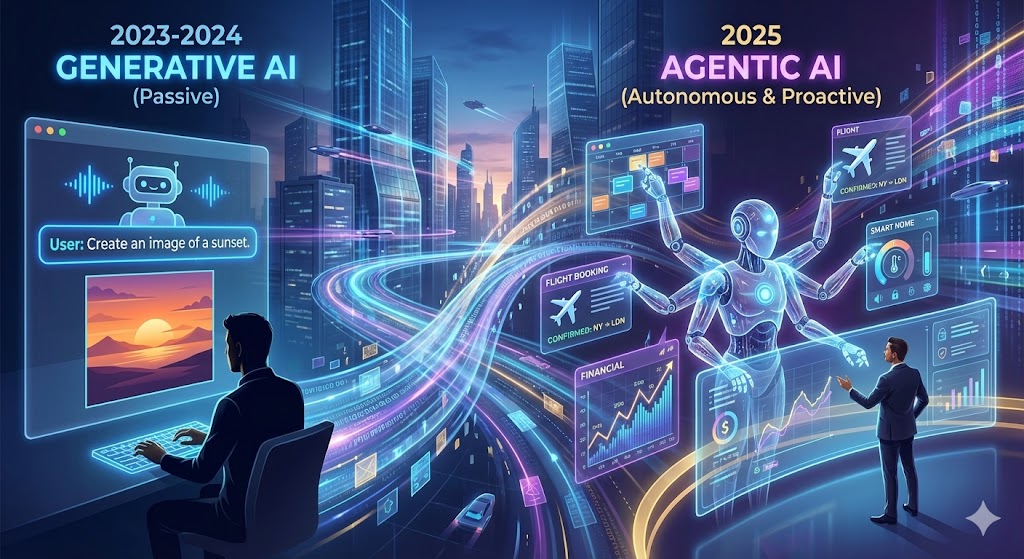
2023 and 2024 saw the rise of “Generative AI” with tools like ChatGPT and Midjourney. However, 2025 marks a new turning point in the technology’s evolution: Agentic AI (Autonomous Agents). According to Gartner’s predictions, 40% of enterprise workflows will involve AI agents by 2025.
Agentic AI is fundamentally different from systems that simply produce text or images. These agents have the ability to “perceive, reason, and act.” When you ask a traditional chatbot, “What are the flight ticket prices?”, it presents a list. An AI agent, on the other hand, checks your calendar, analyzes your budget, selects the best flight, and completes the reservation on your behalf. This is the transition from passive assistance to proactive partnership.
Trend Analysis: The Transition from Generative to Autonomous
2023 and 2024 saw the rise of “Generative AI” with tools like ChatGPT and Midjourney. However, 2025 marks a new turning point in the technology’s evolution: Agentic AI (Autonomous Agents). According to Gartner’s predictions, 40% of enterprise workflows will involve AI agents by 2025.
Agentic AI is fundamentally different from systems that simply produce text or images. These agents have the ability to “perceive, reason, and act.” When you ask a traditional chatbot, “What are the flight ticket prices?”, it presents a list. An AI agent, on the other hand, checks your calendar, analyzes your budget, selects the best flight, and completes the reservation on your behalf. This is the transition from passive assistance to proactive partnership.
Featured AI Agents and Tools
Some of the AI agents that consumers and professionals will encounter and use most frequently in 2025 include:
Sintra AI: A platform designed for entrepreneurs, offering 12 different “assistant” agents specialized for different departments, such as marketing, sales, and support.
AutoGPT: An open-source, autonomous agent for developers that can plan and execute multi-step tasks without human intervention.
Lindy: A personal assistant that automates administrative tasks such as email management, calendar syncing, and CRM updates.
ClickUp Brain: An integrated AI that automates project management processes, enhances team collaboration, and manages documentation.
HubSpot Breeze: A tool that automates lead management and tracking for sales teams, identifying potential opportunities by analyzing CRM data.
Artificial Intelligence Agents: The Digital Assistant Revolution of 2025
We’re used to seeing the promise of a new “revolution” every year in the technology world, but the change we’re experiencing in 2025 has a much more profound and tangible impact than its predecessors. 2023 and 2024 were the golden age of “Generative AI” tools that respond to our commands, write text, or draw images. However, by 2025, a new player has emerged on the scene: Artificial Intelligence Agents (AI). We’re no longer faced with passive software that simply “does what we’re told”; we’re faced with autonomous systems that perceive, think, plan, and, most importantly, act on our behalf. According to Gartner data, more than 40% of corporate workflows will be managed by these intelligent agents this year. So, how is this technological leap transforming our daily lives and the way we do business?
The key characteristic that distinguishes AI agents from traditional chatbots is their action-oriented nature. When you ask a traditional digital assistant, “How much are flights from Istanbul to London?”, they’ll present you with a price list and that’s it. However, an AI agent (like Lindy or AutoGPT) will check your calendar, filter out flights that don’t conflict with your meeting times, analyze your budget preferences, and purchase the ticket on your behalf once you’ve confirmed it. It’ll even make your post-flight hotel reservations and create your packing list based on the weather in your destination city. These systems, which are revolutionizing everything from finance to e-commerce, healthcare to personal productivity, are taking over repetitive and operationally demanding processes, allowing human intelligence to focus on strategic and creative areas.
It would be a mistake to limit the impact of this technology solely to corporate efficiency; the rules of the game are changing for individual users as well. Platforms like Sintra AI allow you to run a one-person business as if you had a team of 12. While your marketing agent plans social media posts, your support agent answers customer emails, and your data analyst agent prepares weekly sales reports. In the healthcare field, agents integrated with wearable technologies can monitor your heart rate and sleep data 24/7, identifying potential health risks before your doctor does and providing early warnings. The year 2025 marks the transition from technology being merely a tool we “use” to a partnership where we “collaborate” with it. In this new era, those who can integrate AI agents into their work and daily life will gain a unique advantage in time management.

